
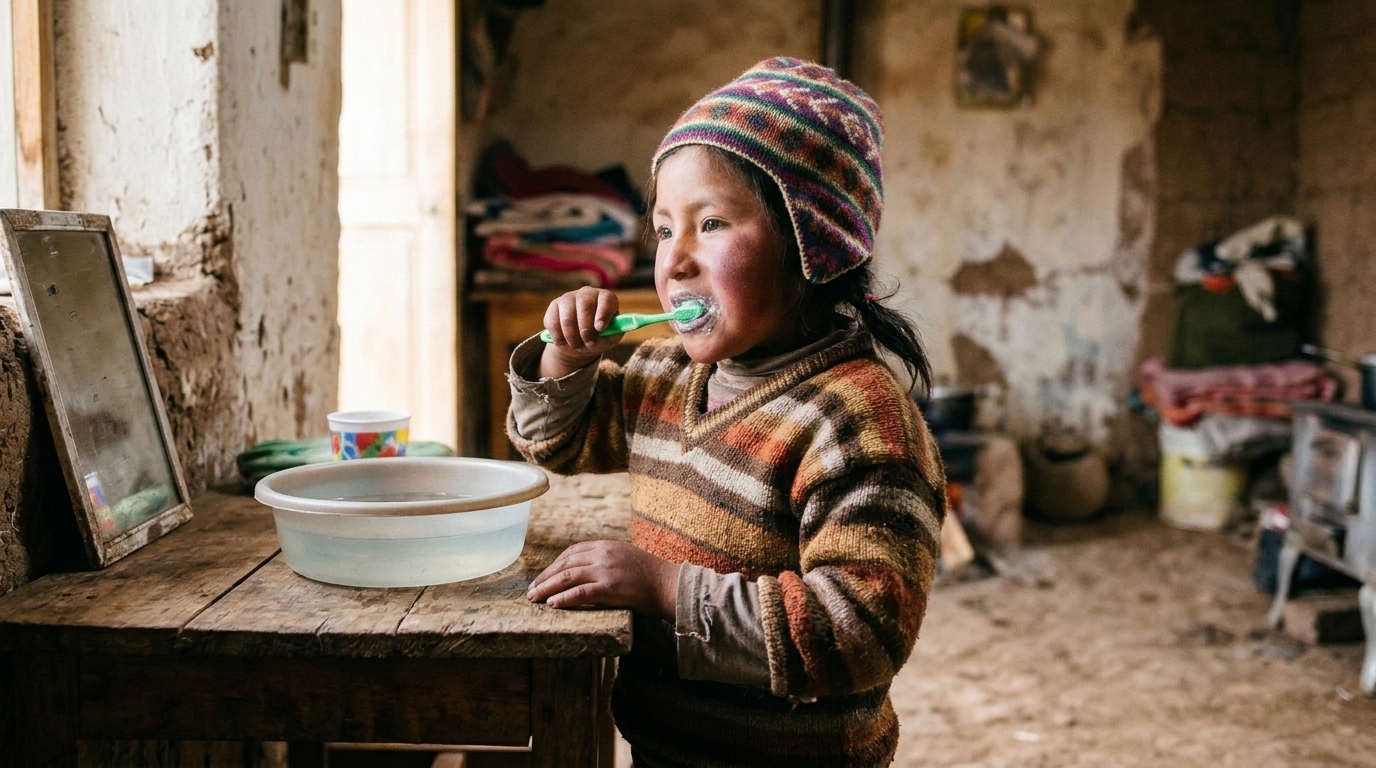
Key facts
- The investigation evaluated nationally representative ENDES 2022 to 2024 data from 52,614 Peruvian children aged 1 to 4 years.1
- Primary preventive oral hygiene prevalence stood at 34.1% in 2022, rose to 37.2% in 2023 and reached 38.2% in 20241
- Four-year-olds had an adjusted prevalence ratio of 2.77 compared to one-year-olds, with higher education linked to an adjusted ratio of 1.77 relative to no or preschool education1
Documented preventive oral hygiene among Peruvian children aged 1 to 4 years increased between 2022 and 2024, according to a repeated cross-sectional analysis of Peruvian survey data.1
Changes in relative indices of inequality were not statistically distinguishable based on a p-value of 0.218..1 The study, published in BMC Public Health, found documented practice improved overall but socioeconomic differences persisted each year.1
Prevalence Rose Across Three Years
Researchers analyzed nationally representative ENDES data to assess recent population-level changes and examine disparities across early childhood..1 The investigation evaluated nationally representative ENDES 2022 to 2024 data from 52,614 Peruvian children aged 1 to 4 years, with 52,517 children having complete records and entering Poisson regression models.1
Primary preventive oral hygiene prevalence stood at 34.1 percent in 2022, with a 95 percent confidence interval from 33.2 to 35.1..1 It rose to 37.2 percent in 2023, with an interval from 37.1 to 39.3, and reached 38.2 percent in 2024, with an interval from 37.1 to 39.3..1 Secondary prevalence also improved during the observation window, rising from 26.2 percent in 2022 to 29.9 percent in 2024.1
Documented fluoride use increased among the children, while reported daily brushing practices changed very little across the same period.1
Age And Education Linked To Higher Rates
Multivariable Poisson models identified several factors associated with documented hygiene practice..1 Four-year-olds demonstrated an adjusted prevalence ratio of 2.77 compared to one-year-olds, with a 95 percent confidence interval from 2.61 to 2.93..1 Higher education showed an adjusted prevalence ratio of 1.77 relative to no or preschool education, with a 95 percent confidence interval spanning 1.42 to 2.20..1 Previous dental attendance was associated with an adjusted prevalence ratio of 1.21, with a 95 percent confidence interval between 1.17 and 1.25.1
Inequality Measures Show Persistent Gaps
Inequality assessments revealed differing trajectories across absolute and relative measures..1 Age standardization changed these inequality estimates only slightly..1 Age-standardized slope indices of inequality registered at 16.3 percentage points in 2022, 19.9 percentage points in 2023, and 22.0 percentage points in 2024, with an estimated change from 2022 to 2024 of 5.7 percentage points, a 95 percent confidence interval from 0.7 to 11.5..1 Relative indices of inequality were 1.62 in 2022, 1.71 in 2023, and 1.77 in 2024, with changes that were not statistically distinguishable based on a p-value of 0.218.1