
Key facts
- The workshop, organized by the Uttar Pradesh State Institute of Forensic Science, the Department of IT and Electronics, the Data Security Council of India and Cisco, took place on 25 November 2026 at the Pragya Conference Hall in Lucknow.1
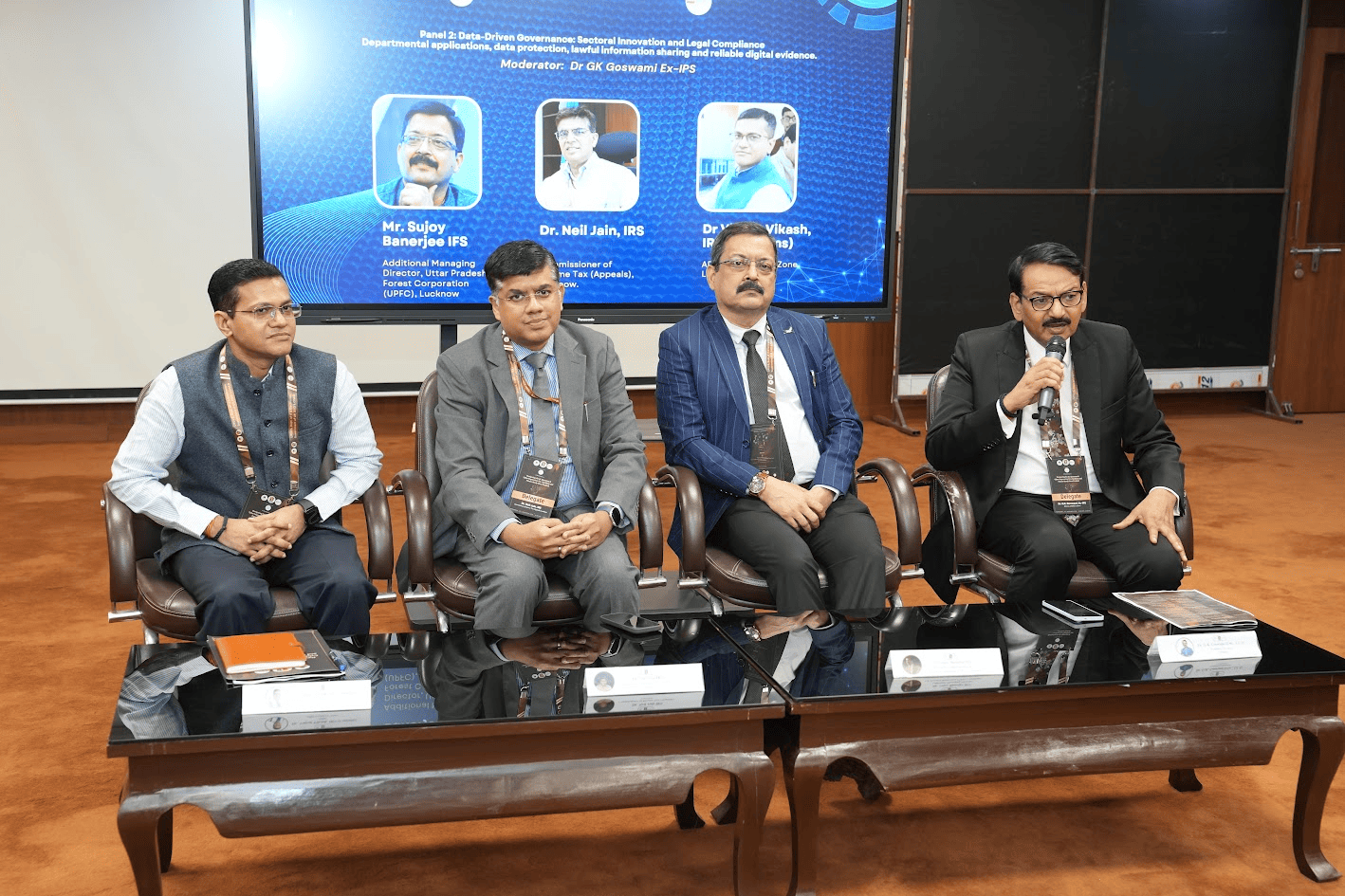
- The panel examined AI and data-driven technologies across government departments, including forest management, tax administration and law enforcement, and discussed how AI can improve administrative efficiency, facilitate citizen-centric governance and assist in identifying crimes.1
- Dr. Sujoy Banerjee, IFS, Additional Managing Director of the Uttar Pradesh Forest Corporation, said AI could help manage forest inventory at the level of individual trees and assist in human-wildlife conflict, while Dr. Neil Jain, IRS, Commissioner of Income Tax (appeals), and Dr. Vidyut Vikash, IRS (Customs), ADG DRI Lucknow Zone, discussed AI applications in their own departments.1
A workshop examining the use of artificial intelligence and data-driven technologies across government departments, including forest management, tax administration and law enforcement, took place on 25 November 2026 at the Pragya Conference Hall in Lucknow.1
The workshop was organized by the Uttar Pradesh State Institute of Forensic Science, the Department of IT and Electronics, the Government of Uttar Pradesh, the Data Security Council of India and Cisco.1
Panel Examines AI in Government Departments
The panel examined how AI can improve administrative efficiency, facilitate citizen-centric governance, assist in identifying crimes and strengthen information management..1 The panellists also highlighted the importance of data protection, legal compliance and safeguards while adopting AI-based tools in government functioning.1
Dr. GK Goswami, an Ex-IPS Officer, moderated the panel..1 He introduced the panellists and gave a brief background of the topic of discussion..1 Goswami said with the rise of new technology like AI, there was an increasing need to deliberate upon data management, data protection and cyber security..1
AI in Forest Management
Dr. Sujoy Banerjee, IFS, Additional Managing Director of the Uttar Pradesh Forest Corporation, spoke about the application of AI in the forest department. He highlighted the substantial resources held by forests and the importance of maintaining an accurate inventory. Banerjee explained that considering approximately 200 trees per hectare and an estimated value of each tree at around Rs.1
He pointed out that forest boundaries were not always clearly demarcated and that forests faced inadequate protection and encroachment..1 Banerjee referred to the Forest Conservation Act, 1980, and observed that encroachment had taken place in the past partly because people expected to receive land parcels at a later stage..1 He identified several areas in which AI could be deployed, including forest inventory management at the level of individual trees and human-wildlife conflict..1 Banerjee explained that when people encroached upon forest areas, wild animals sometimes moved outside forests, damaged crops and, in certain cases, injured or killed people, creating serious challenges.1
Discussing his work with the Uttar Pradesh Forest Corporation, Banerjee explained that while the Forest Department was engaged in protecting trees, the Corporation was involved in cutting and selling them..1 He said smart cameras were already being used to count logs, identify incoming trucks and record their weight..1 Banerjee referred to the use of spatial technologies, including maps and Geographic Information Systems, for monitoring forests..1 He recalled his previous posting in Gonda as Chief Conservator of Forests and Wildlife.1
AI in Tax and Customs
Dr. Neil Jain, IRS, Commissioner of Income Tax (appeals), and Dr. Vidyut Vikash, IRS (Customs), ADG DRI Lucknow Zone, discussed AI applications in their own departments..1 Jain and Vikash did not speak in detail about their own departments, but both identified areas in which AI could be deployed..1 Jain referred to the use of AI in tax administration, while Vikash referred to the use of AI in customs and customs enforcement.1
The discussion concluded with a call for legal compliance and safeguards in the adoption of AI-based tools in government functioning.1