
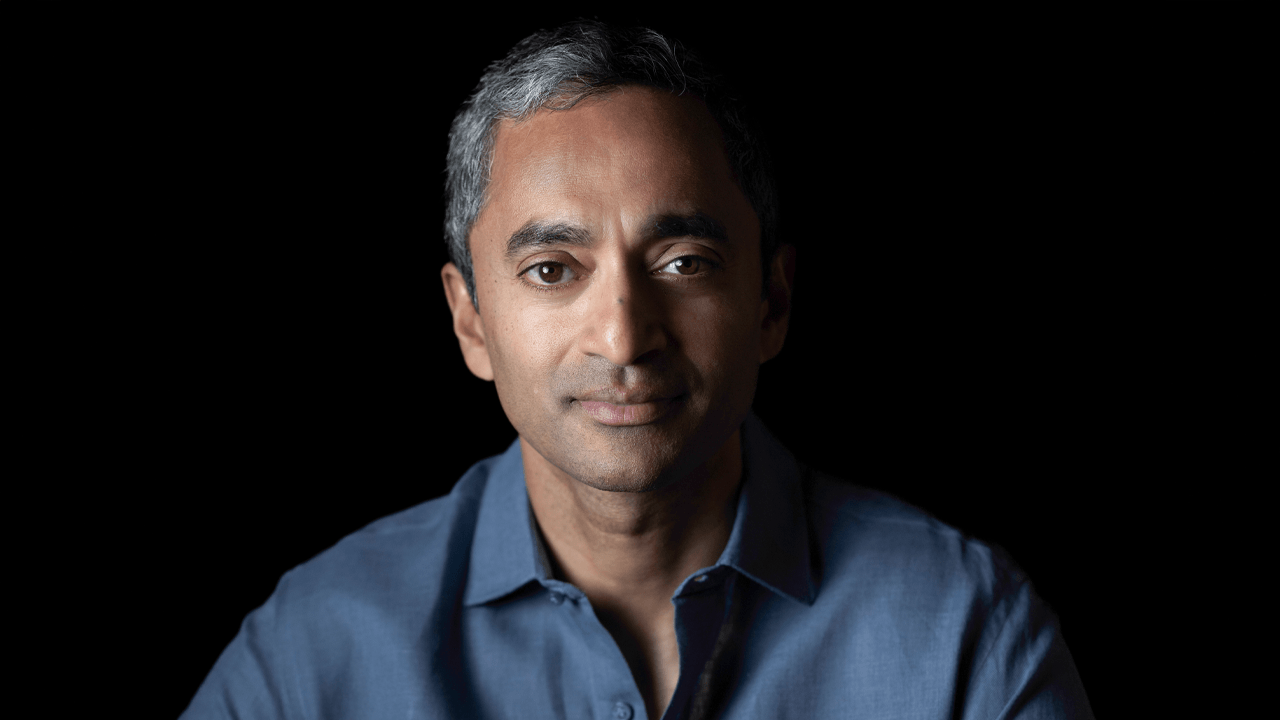
Key facts
- Chamath Palihapitiya warned Friday that AI could eventually dismantle the cryptographic foundations securing Bitcoin.1 Michael Saylor and Blockstream’s Adam Back disputed Palihapitiya’s thesis on Nov. 27.1 Stacks co-founder Muneeb Ali challenged Palihapitiya’s assumptions about Bitcoin’s capacity to implement future-proof cryptographic upgrades.1
- The Ethereum Foundation is working towards a transition to alternative cryptographic methods by 2029.2
- Chamath Palihapitiya revisited the history of RSA cryptography, introduced in 1977.1 According to Palihapitiya, one of RSA’s inventors initially estimated that factoring a 125-digit number would require 40 quadrillion years.1 By 1994, volunteers had factored a larger, 129-digit number in eight months through improved algorithms and greater computational resources.1 Bitcoin’s digital signatures rely on elliptic-curve cryptography rather than integer factorization.1
K33 is a research and brokerage firm.2 K33 warned that rapid advances in artificial intelligence and mathematics could eventually raise new questions about cryptocurrency security.2 K33 stressed that recent breakthroughs have not shown that Bitcoin’s cryptographic protection has been compromised.2
The debate intensified after Anthropic mathematician Levent Alpöge announced a proposed proof of the Riemann Hypothesis..2 Levent Alpöge announced the proposed proof with assistance from the company’s Claude AI model..2 The proposed proof reportedly passed independent computational checks..2 Academic review of the proposed proof remains ongoing.1
Bitcoin’s cryptographic architecture
K33 explained that Bitcoin transactions rely on elliptic curve cryptography.2 K33 discussed the famous P versus NP problem, which remains unsolved..2 Even if researchers eventually prove that P equals NP, it would not automatically produce a practical algorithm capable of recovering Bitcoin private keys quickly enough to threaten the network.2
The Ethereum Foundation has doubled its protocol security team..3 The Ethereum Foundation is working towards a transition to alternative cryptographic methods by 2029.2 K33 believes the industry should monitor AI developments and prepare for possible future risks without assuming that Bitcoin’s existing security has already been defeated.2
Chamath Palihapitiya warns AI could crack Bitcoin
Chamath Palihapitiya warned Friday that AI could eventually dismantle the cryptographic foundations securing Bitcoin..1 Michael Saylor and Blockstream’s Adam Back disputed Palihapitiya’s thesis on Nov. 27..1 Stacks co-founder Muneeb Ali challenged Palihapitiya’s assumptions about Bitcoin’s capacity to implement future-proof cryptographic upgrades.1
Palihapitiya’s essay expanded on arguments he made approximately a month earlier during an appearance on the Moonshots podcast..1 Palihapitiya said the controversy prompted his team to examine the mathematical assumptions behind his position, consult experts, and prepare a more comprehensive explanation for subscribers..1 Palihapitiya’s central argument concerns the potentially diminishing interval between the establishment of cryptographic security assumptions and the discovery of mathematical techniques capable of invalidating them.1
Palihapitiya revisited the history of RSA cryptography, introduced in 1977..1 According to Palihapitiya, one of RSA’s inventors initially estimated that factoring a 125-digit number would require 40 quadrillion years..1 By 1994, volunteers had factored a larger, 129-digit number in eight months through improved algorithms and greater computational resources..1 Bitcoin’s digital signatures rely on elliptic-curve cryptography rather than integer factorization.1
Palihapitiya believes AI could accelerate mathematical discovery beyond conventional expectations..1 Palihapitiya cited mathematician Levent Alpöge’s collaboration with Anthropic’s Claude on a proposed proof of the Riemann hypothesis..1 The Riemann hypothesis is a famous mathematical conjecture dating to 1859..1 Independent organizations have computationally verified the proposed proof, although broader academic scrutiny remains ongoing..1 The achievement itself does not establish a cryptographic vulnerability.1
Anthropic disclosed in July 2026 that Claude Mythos Preview discovered a computational attack against a reduced, seven-round version of AES-128 that operated 200 to 800 times faster than the previous best method..1 The experiment did not compromise the complete 10-round cipher or establish an attack against Bitcoin..1 Palihapitiya acknowledged Bitcoin’s ingenious combination of existing cryptographic primitives, economic incentives and decentralized ledger maintenance..1 Bitcoin incorporates the SHA-256 hash function, elliptic-curve digital signatures and a proof-of-work consensus mechanism.1
Palihapitiya disclosed during his October podcast appearance that he had shifted his direct bitcoin exposure into equity through Digital Currency Group years earlier, citing storage and security concerns.1 K33 released a report on Friday stating that recent advances in artificial intelligence have not demonstrated a break in Bitcoin’s network security..3 As of 02:42 UTC, Bitcoin traded at $59,978, -2.6% over 24 hours..3 With $27.8 billion in 24-hour volume.3