

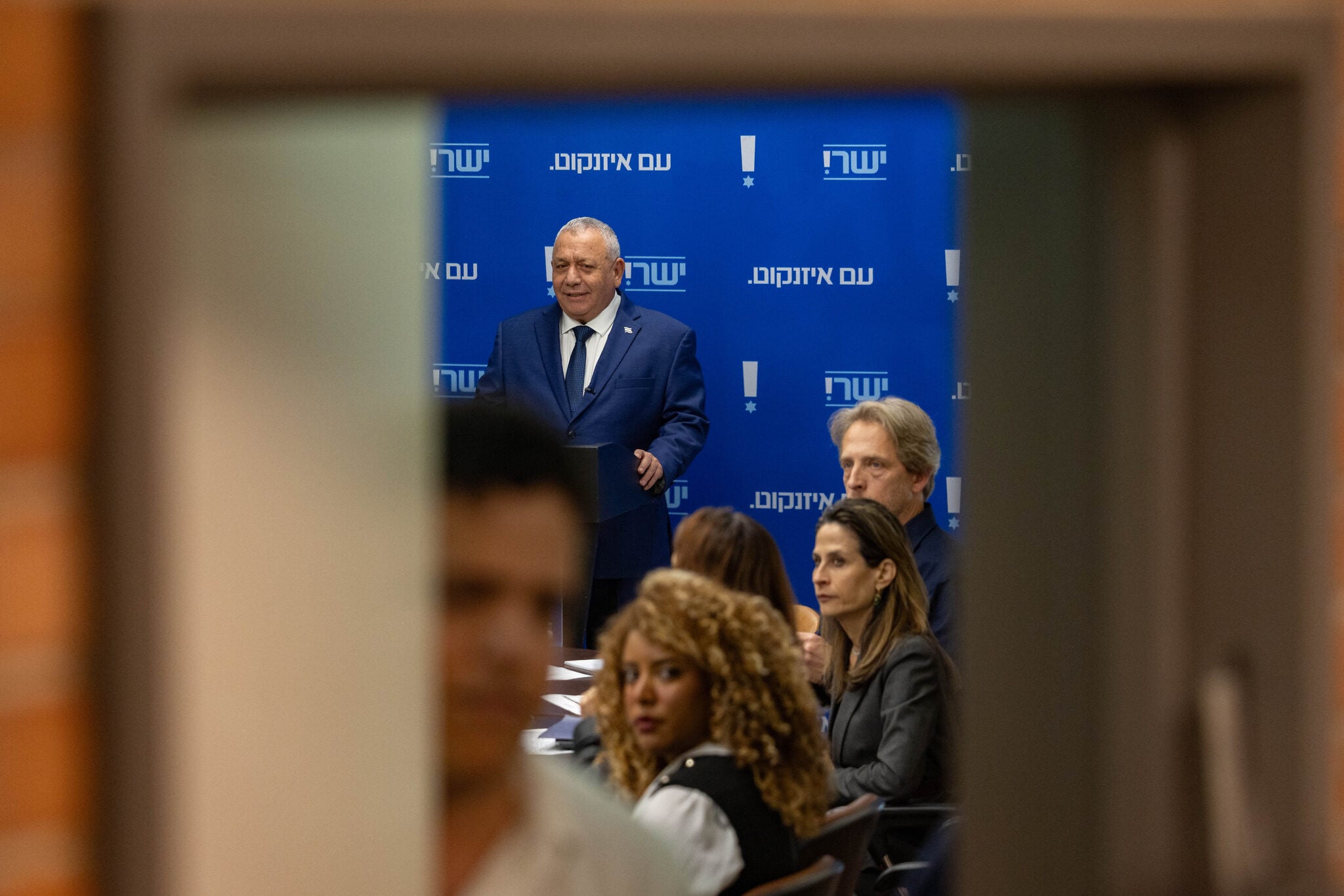
Key facts
- Some of Eisenkot’s allies have voiced opposition to relying on the support of the Arab-majority lists.1
- Gadi Eisenkot said on Friday that Prime Minister Benjamin Netanyahu has been dragging out the negotiations.2
- On Friday, Israeli media reported that Mansour Abbas, the leader of the Arab-Israeli Raam party.1
Gadi Eisenkot Gadi Eisenkot accused the Likud party of stalling coalition talks in a bid to bring about new elections.3
Eisenkot is the leader of the centrist Yashar party.3
Following the October 27 election, Israel’s president tapped Eisenkot to form a new government.3
Eisenkot has until December 6 to form a government to replace Netanyahu.3
The deadline can be extended by 14 days.3
The election failed to deliver a clear majority for either bloc.3
Eisenkot and his presumed partners won 48 seats in the 120-seat parliament.3
Netanyahu and his traditional alliance of right-wing and ultra-Orthodox parties won 53 seats.3
The Yashar party has so far agreed coalition deals with the left-leaning Democrats party and the right-wing Israel Beiteinu party.3
Together, the Democrats, Israel Beiteinu and Yashar have a combined total of 36 MPs.3
Yashar negotiators have held talks with Netanyahu’s right-wing Likud party over the possibility of forming a national unity government involving both parties.3
Eisenkot’s camp has faced divisions on whether to forge alliances with ultra-Orthodox parties or the Arab-majority lists.3
Likud accused Eisenkot of working to form a “dangerous left-wing government.”3
Likud said it would still be open to a unity government.3
Eisenkot’s Accusations
Gadi Eisenkot is trying to form the next Israeli government.1
Eisenkot’s centrist Yashar party has in recent days agreed coalition deals with two allied parties.1
After the October election failed to deliver a clear majority for either bloc, Yashar has held talks with Likud over the possibility of forming a national unity government involving both parties.1
No breakthroughs on the Likud-Yashar national unity government have ostensibly been reached.1
Eisenkot’s wide-ranging camp has faced divisions on whether to forge alliances with the ultra-Orthodox parties, or the Arab-majority lists, or whether to form a unity government with Likud.1
Netanyahu’s Response
On Friday, Israeli media reported that Mansour Abbas, the leader of the Arab-Israeli Raam party, was expected the following day to recognise Hamas as a “terror group.”1
Some of Eisenkot’s allies have voiced opposition to relying on the support of the Arab-majority lists, which won unprecedented gains in the election.1
Gadi Eisenkot is the leader of the Israeli opposition bloc.4
Gadi Eisenkot is the Israeli opposition leader tasked with forming the next Israeli government.2
Gadi Eisenkot said he intends to form a new government within the eight days remaining in his mandate.4
Gadi Eisenkot accused Prime Minister Benjamin Netanyahu’s Likud party of conducting unity negotiations without any genuine intention of reaching an agreement.4
Eisenkot said the two sides had held five meetings over two weeks.4
Likud allegedly refused to make concrete proposals or compromise on key issues.4
Likud allegedly refused to remove right-wing parties from the government.4
Likud allegedly refused to establish a state commission of inquiry into the October 7, 2023 attack.4
Likud allegedly refused to pass legislation requiring broader military service.4
Eisenkot accused Likud of deliberately delaying negotiations to divide the opposition and force another election.4
Eisenkot said his bloc had offered significant compromises on judicial reform and the proposed inquiry.4
Likud accused Eisenkot of conducting a political double game.4
Likud claimed Eisenkot was already assembling an alternative coalition, distributing ministerial portfolios and preparing to rely on Arab parties.4
Likud described Arab parties as supporters of terrorism.4
Naftali Bennett is the leader of Israel’s opposition faction Together.4
Naftali Bennett said he prefers forming a national unity government.4
Naftali Bennett said if this proves impossible, the bloc will move forward with a less desirable alternative.4
Earlier this month, Netanyahu called for the formation of a national unity government.4
Netanyahu asserted that the country must remain united in the face of what he described as a growing threat from Iran.4
Netanyahu warned that the country could soon come under intense international pressure to accept a nuclear-armed Iran and the continuation of its current regime.4
Netanyahu accused the current regime of posing an existential threat to Israel.4
Deadline And Extension
Eisenkot has until Dec 6 – a deadline which can be extended by 14 days – to form a government, after October elections failed to give either camp an absolute majority.1
According to Haaretz, sources close to Eisenkot’s bloc expect Netanyahu to make a significant offer next week to prevent the government Eisenkot is planning from being sworn in.2
Yashar and Likud met five times over the past two weeks to negotiate.2
Eisenkot said Likud had refused on several days to schedule meetings as frequently as his party proposed.2
Gadi Eisenkot, the Israeli opposition leader who is tasked with forming the next Israeli government, said on Friday that Prime Minister Benjamin Netanyahu has been dragging out the negotiations, even though his Yashar Party is willing to agree on key points, Haaretz reported.2
A former army chief of staff, Eisenkot has until 6 December to form a government, with the possibility of a 14-day extension, after October elections failed to give either camp an absolute majority.2