
Key facts
For years, Badlands National Park in South Dakota has been battling a devastating pneumonia outbreak in its bighorn sheep population.1
Beginning in 2021, the park lost about 85 percent of its bighorn sheep to the illness, which can linger in infected herds for decades.1
United States
An estimated 2 million bighorn sheep once roamed across the contiguous United States..1 The bighorn sheep population plummeted to just 20,000 following European settlement..1 Bighorn sheep disappeared entirely from South Dakota due to overhunting, introduced diseases and other human impacts by the early 20th century.1
In 1964, bighorn sheep were restored to the Badlands for the first time..1 Eddie Childers is a wildlife biologist at Badlands National Park..1 He started working at the park in the 90s and helped translocate a second group of bighorns from New Mexico in the early 2000s.1
Childers said the badlands sheep population kept growing..1
“By the time we came to 2021, we had over 350, 400 bighorn sheep parkwide,” Childers said.
A bacterial infection spreads
A pneumonia outbreak caused a significant die-off of bighorn sheep in the badlands starting five years ago..1 The bacterial infection is transmitted from wild sheep coming in contact with domestic sheep and goat herds..1 There’s no treatment or vaccine for bighorn sheep pneumonia, and once introduced, it has long-lasting consequences.1
Chronic shedders can spread the disease for years, causing Bighorn pneumonia to persist in infected herds for decades..1 Chronic shedders often pass the illness to newborn lambs, which have an extremely low survival rate during the first few months of life if they’re infected.1
“What often happens is a male during the rut will roam outside the park, find a domestic herd, come in contact with the pathogen, and then come back to the park,” Childers said.
One
One of the emerging management strategies for bighorn sheep pneumonia is to remove chronic shedders from the population..1 This improves lamb recruitment and gives the herd a chance to recover.1
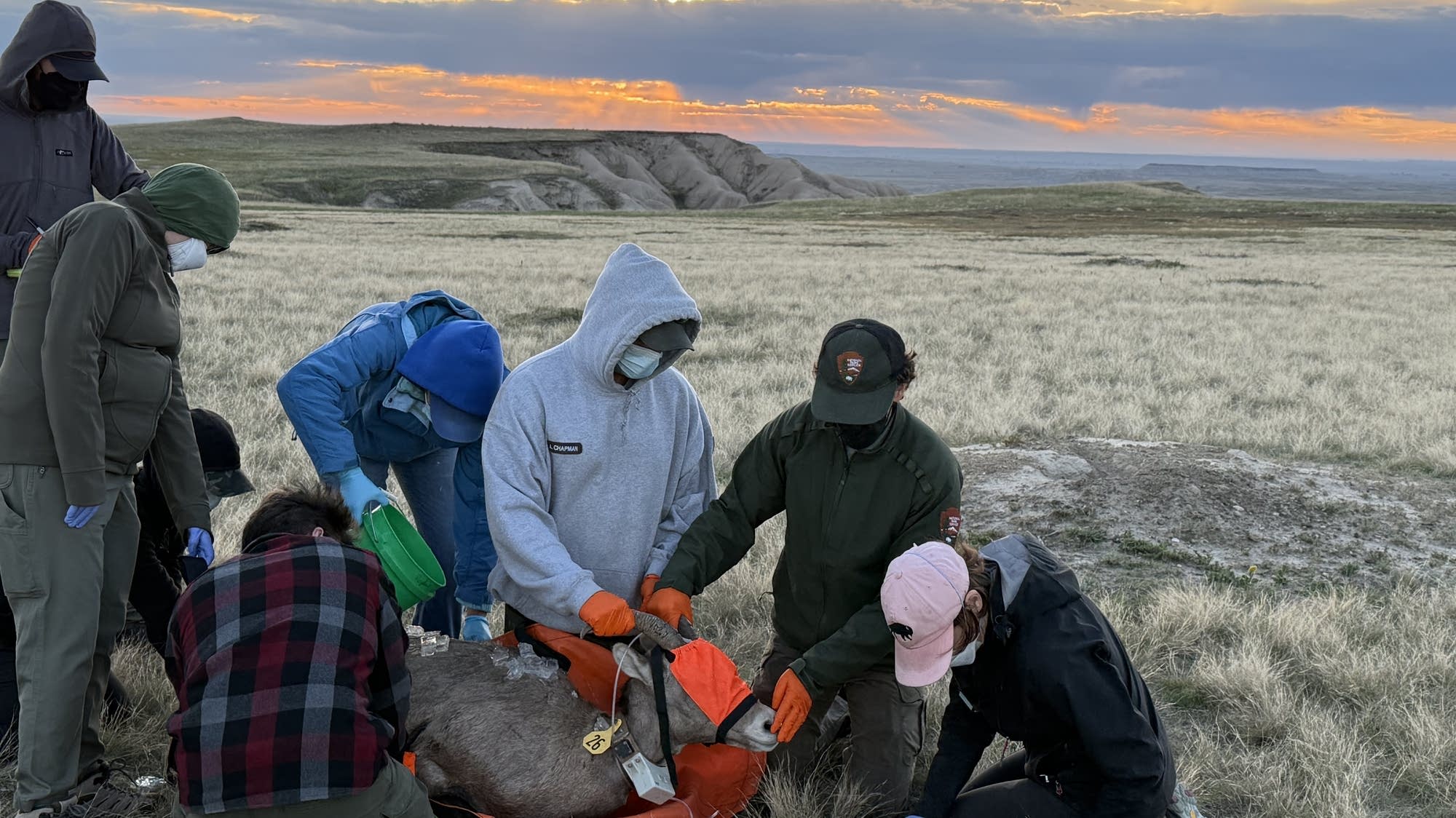
Childers said the park has been working to do this by aerial capturing every bighorn sheep still alive in the badlands, then testing and monitoring them with a collar..1
“We just kept doing that over the last three or four years,” Childers said. “We had to make some difficult decisions because if they’re chronic shedders, you really need to move them out of the population. And so we did. And right now, as it stands, we have completely eradicated all the chronic shedders, all the diseased sheep that are in the North Unit. And we’ve eliminated all but three in the South Unit.”
A small herd, but hope
Today, there are a little over 50 bighorn sheep living in the badlands..1 While that’s well below pre-outbreak numbers, Childers is optimistic because every lamb in the park has so far survived past the 90-day mark.1
Childers hopes the park can translocate more healthy bighorn sheep from another area of western North America to continue rebuilding the herd.1